1A city survives the bomb, and a company does not survive a bad decade
On 9 August 1945, three days after the bomb, a tram ran in Hiroshima. It covered a short stretch of track on the west side of the city, on current borrowed from a substation fifteen kilometres out. The company that ran it had lost a hundred and eighty-five of its people, and a hundred and eight of its hundred and twenty-three cars were damaged or burnt, and the driver of the first car told the staff that anyone without money could ride for free.1 The fare was the rule. He set it aside because he knew what a tram was for, and so did everyone who climbed on.
By the middle of the 1950s Hiroshima and Nagasaki were back to the size they had been before the war. The economists who later measured the bombed cities of Japan found the pattern in all of them: within about fifteen years each was back on the growth path it had been on before the bombing, as if the destruction had been weather.
No company has come back from anything comparable, and most do not come back from a bad decade. When I first wrote about this, in December 2023, I said that the average lifespan of a Fortune 500 company had fallen from sixty-one years to eighteen in six decades. The numbers are real and I described them wrongly. They are Richard Foster’s measure of how long a company stays in the S&P 500 index, and a company leaves an index by shrinking or by being bought as well as by dying.2 The better number is less dramatic and more disturbing. Geoffrey West’s group at the Santa Fe Institute followed more than twenty-five thousand listed American companies from 1950 to 2009 and found that half of any cohort is gone within about ten years, by merger, acquisition or failure, in every sector, and that a company’s chance of disappearing next year does not depend on how old it is.3 A firm that has lasted a century is no safer than one that has lasted a decade. Whatever companies learn by surviving, it is not how to survive.
I am a sociologist by training and have spent my working life in software, and that contrast sits where the two meet. A form of organisation with a chief executive, a strategy and a budget dies at a constant rate, and a form with none of the three survives a nuclear weapon.
2An order loses its reason on the way down
In January a chief executive tells her leadership team that the company has drifted away from its customers and has to move close to them again. By March that sentence is a target, four customer visits a month for every account manager. By June it is a mandatory field in the sales system, and visits are being logged that never took place, because the record will not save with the field empty. Three years later she has left, the field is still mandatory, and there is no one in the building who can say what it is for.
Work is a group of people organised around an outcome, with a goal they share. Underneath the outcome is a purpose: a return for the shareholders, an effect on the lives a charity exists for, and for most of us the wish that the hours should mean something. A company of any size moves that purpose by relay. The top issues marching orders, each tier passes them to the next, and at the bottom they turn into actions. Every relay keeps the instruction and drops the reason, because the instruction is shorter, can be checked, and is all the next person needs in order to act. What arrives at the bottom is the what, and the why stayed upstairs.
James March and Herbert Simon described this in 1958 and called it uncertainty absorption: the point in an organisation where conclusions are passed on in place of the evidence they were drawn from, so that whoever receives them can neither check them nor adapt them.4 In 2023 I called it information entropy. The name matters less than the arithmetic, which is that the loss compounds with every tier, so the orders that come through intact are the simple ones.
Armies found this out before companies did, and the most hierarchical institution we have is the one that fixed it. After its defeat by Napoleon the Prussian army spent half a century learning that an order which arrives without its reason is useless the moment the situation changes, and the situation changes at first contact. Moltke’s answer was to write the reason into the order: tell the subordinate what is to be achieved and why, and leave the how to the man who can see the ground. Every modern army has a version of it, and the American one calls it commander’s intent.5 A company’s chain of command looks military and is cruder than the military’s, because it transmits the instruction and keeps the intent at headquarters. An organisation can adapt as far down as its reasons reach, and in most companies they stop two floors from the top.
3A digitised process is a work-to-rule strike that never ends
When the taxi drivers of Paris wanted to punish the city, they went on working and followed the traffic code, every article of it, until central Paris stopped moving. The French call it a grève du zèle, a strike of zeal, and the English name is working to rule.6 It succeeds wherever it is tried, on railways, in customs halls and in hospitals, and what it demonstrates is awkward for anyone who designs processes: no organisation survives its procedures followed to the letter.
The procedure is a sketch. What keeps the trains running is the thousand daily adjustments made by people who know what the procedure is for: the form waved through because the customer is standing there, the step skipped because the lorry is waiting, the phone call that goes round the approval chain. James Scott, who collected these cases, stated it as a rule, that a formal order lives off an informal one it does not acknowledge and could not run without. For as long as processes ran on paper, telephones and people, the informal order came free with the staff. The process was inefficient, and it bent.
Then we digitised it, in the name of efficiency, and software is the first medium in which the rule is followed to the letter every time, by a worker that cannot be argued with, at any scale. The record will not save with the field empty. The order will not release without the third approval. Changing the rule takes a project, a budget and a vendor, so the rule outlives its reason by years, and the people inside it spend their ingenuity on going round it, in spreadsheets and side channels the company cannot see.7 A digitised process is a work-to-rule strike that never ends. A ticket machine in Hiroshima would have charged the fare.
I cannot prove that the software did it. Companies leave the index for reasons that have nothing to do with their systems: cheap capital and the mergers it pays for, activist shareholders, regulation, the plain fact that markets move. West’s half-life of a decade is an average over sixty years and does not single out the software era. What I hold is narrower, and I hold it firmly. Digitisation removed the cheapest means of adaptation a company had, the discretion of the person doing the work, at the moment the environment began to change faster, and a company that cannot bend at the bottom has to be steered from the top, through the relay that loses the reason. That is a mechanism, and the evidence for it is the strike.
4A city fixes the streets and leaves the rest to whoever turns up
On 18 July 2013 the city of Detroit filed for bankruptcy with debts of about eighteen billion dollars, the largest municipal failure in American history. Seventeen months later it was out, and at no point in between did anyone suggest that Detroit would cease to exist. A company in that position becomes a logo owned by a fund.
Companies are one of several structures people have built for reaching outcomes as a group, alongside religions, states and cities, and the city is the instructive one because it is so hard to kill. West and his colleagues measured why. Double the population of a city and its wages, patents and new businesses more than double, while the roads, cables and petrol stations it needs rise by less than double; companies scale the other way, like animals, with returns that flatten as they grow.8 Crime and disease rise with the wages, which West is careful to say and the boosters of cities are not. His book is where I learned to see a company as a system that scales and dies. It stops short of software, which is the medium companies run in, and the omission matters, because the medium is where the difference between the two forms is fixed.
A city has no chain of command for meaning. No mayor decides what the bakery is for. The purpose of each activity in a city is held by the people doing it, where it can change on the day the circumstances do. What the city fixes is small and generic: the street plan, the property lines, the law, the water. Those rules change slowly and in public, and inside them the routes are free. A company does the reverse: it holds the purpose at the centre and fixes, in software, at the edge, the steps each person takes. So a city can lose any building, any firm and any mayor, because a city was never the sum of them,9 and a company cannot lose its purchasing system.
An economist will say that company death is the system working, and for the economy it is: capital and people go on to better uses. What does not go on is what the company knew. The reasons behind its rules lived in heads and in software, the heads disperse, the software is switched off, and the loss appears in no set of accounts. A city also has an advantage it did not earn, which is that it has no purpose to fail at, while a company exists for something and somethings expire. The lesson of the city is narrower than immortality. Keep fixed what is generic, keep the reasons where the work is, and an organisation can lose a great deal and still be there in the morning.
5The agent dies the way the company does
In November 2023 a team led from Peking University published an agent called JARVIS-1 that plays Minecraft through the screen and controls a person uses. Asked to chop down a tree, it succeeds nearly every time. Asked for a diamond pickaxe, which means wood, then a crafting table, a wooden pickaxe, stone, a furnace, iron and a long dig in the dark, it succeeds one time in eight, and that was five times better than any agent before it.10
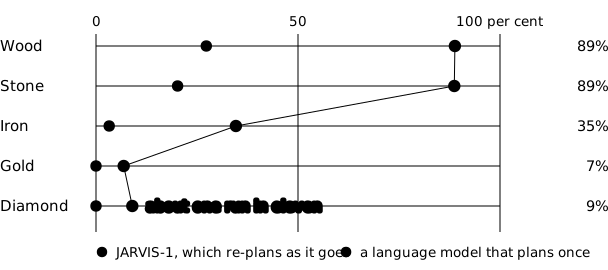
A long task is a chain in which one failed link fails the task, so the odds multiply: an agent that does each step right nineteen times in twenty finishes a twenty-step task about one time in three. When Toby Ord fitted that model to the best measurements we have of agents doing real work, it fitted well enough that he could give each agent a half-life, a constant chance of failing in every minute of the task, with success falling away exponentially as the task runs longer.11 That is the curve West found for companies. A constant hazard is how a system dies when nothing it learned by surviving the last step makes the next one safer, and it describes an agent in a mine and a firm in a market equally well.
In 2023 I drew the easy conclusion first, that people are still better than machines at second- and third-order problems, and then turned it over. We beat the agent at Minecraft because we are playing. We hold the goal ourselves, so when the cave floods we know what would count as a way round. The agent has been handed a sub-goal of a sub-goal by a planner, and when the world departs from the plan it has an instruction and no reason, like the account manager with the mandatory field. At work most of us are in the agent’s position, and we perform like it. Forty years of experiments say so from the other side: hand people the reason for a task from outside, as a reward or an order, and they do worse at anything that needs thought than they do when the reason is theirs.12 Daniel Pink made a bestseller of those experiments in 2009, and companies read it and kept the relay.
The agents of 2026 are far better than JARVIS-1. By METR’s measurements the length of task an agent can finish half the time has doubled about every seven months for six years. The curve has moved out and kept its shape, and each new model has a longer half-life and still has one. My claim is that the shape comes from the way the work is handed over, as instructions stripped of their reasons, and that it will hold until that changes. Command and control fails the machine for the reason it fails the clerk.
6A founder is the last person in the building who remembers why
Between 1990 and 2014 the companies in the S&P 500 that were still led by their founders returned 3.1 times as much to shareholders as the rest, and 1.8 times as much with the technology companies taken out. A separate study found that they produced thirty-one per cent more patents.13
The founder is the one place in a company where the reason has not been through a relay. Everyone else received the purpose, and the founder is where it came from, so the founder can restate it for a situation no one planned for without asking permission. In 2023 I put it as less information entropy: for a while, and up to a certain scale, the signal is stronger. Founders also do what the chain forbids and go round it, into the meeting three tiers down, and in 2024 Paul Graham gave that habit a name, founder mode, which a good part of Silicon Valley recognised on sight.
What happens when the founder goes was described a century ago. The organisation has to turn a person into procedures, and it writes the rules, the offices and the statement of values. Max Weber called this the routinisation of charisma, and the routine does what the relay does: it keeps the instructions and loses the reason.14
The evidence flatters founders more than it should, and I am one. The index counts the founders whose companies reached it and leaves out the larger number whose refusal to let go is the reason theirs did not, and Noam Wasserman’s data on thousands of start-ups says that founders who keep control tend to finish with less valuable companies. The hedge I wrote in 2023 was the right one. A founder is a single point of failure with a fixed bandwidth, and a company outgrows the distance one person can walk. The founder is a patch for a missing capability, the capability of keeping the reason attached to the instruction, and a company that depends on the patch dies with it or soon after.
7Write the reason down, and leave the route free
For fifty years software was a calculator. It could take an instruction and nothing else, so digitising a process meant stripping it down to instructions, and the reason was left outside the code because the code had nowhere to put it. A machine that reasons can take the reason. For the first time we can hand software what Moltke handed a subordinate: the purpose, the end state that would count, the constraints that may not be broken, and the freedom to find the route.
That changes what is worth building. In 2023 I wrote that most enterprise software would be irrelevant or anachronistic within ten years, and that what replaces it would be organised around the work and not around the application. The work is the purpose and the people around it. Software fit for it holds the intent and the goal, and keeps them attached to every action taken in their name, so that a rule can be challenged by anyone who can show it no longer serves its reason. It fixes little, slowly and in the open, as a city does. It treats people and models as participants who find routes, where the software we have treats them as clerks who follow one.
That is what we are building at Beyond Work, and I said so in 2023 before I knew how hard it was. It is under construction and I claim no result for it here.15 The bet is that a company built this way bends at the bottom again, as companies did when their processes ran on people, without giving back what software bought. If the bet is right it will show where West would look for it, in the half-life. Companies that live longer and stay truer to what they were for are better for their shareholders and better for the people who spend their working lives inside them, and what they know does not have to be rebuilt from nothing every ten years.
Three days after the bomb a driver in Hiroshima took a tram out along a short stretch of track and let people ride for nothing. No one had told him to, and no one needed to tell him what a tram is for. The company he worked for is still running trams in that city, and two of the cars that survived that morning are still in service. A company can outlive almost anything while the people in it know what it is for, and almost nothing once only the software does.16